Partnership initiative creates new route to a maritime career
Programme involving SDS to improve productivity at BAE Systems is hailed a success
A pilot programme aimed at helping BAE Systems address maritime skills needs has succeeded in giving more people a route to a new career in the sector.
Funded by the Scottish Government through Glasgow City Region, BAE Systems worked with Jobs & Business Glasgow with support from Skills Development Scotland (SDS) to pilot a new entry-level job role – Trade Support Operative (TSO).
The project followed the creation of the Work Optimisation River Clyde Group (WORC), which brought together a cluster of maritime employers alongside local employability provision and SDS.
The group’s remit was to explore initiatives and collaborative routes to addressing skills challenges across the sector.
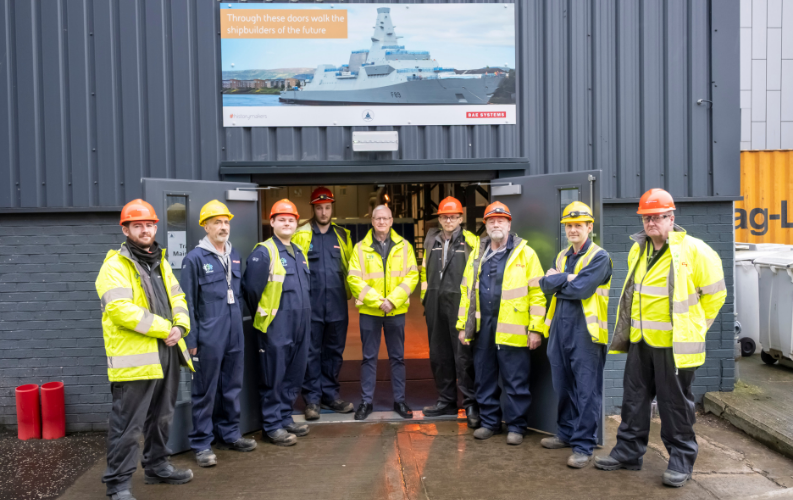
They worked in partnership with Glasgow Clyde College (GCC) to collaboratively create a four-week course introducing shipbuilding skills, tailored to the specific needs of the project.
Stevie Bradley, Capability Lead for Outfitting at BAE Systems said: “We had the opportunity to reach out to people who were unemployed to bring them into the yard.
“The role of the TSO is really valuable, assisting the tradespeople by getting materials, setting up jobs, tidying jobs after completion and putting tools away. Since the pilot started the value of the TSO role has grown within their teams. It saves a lot of the tradespeople’s time and has improved productivity within the business. There’s a clear demarcation between the TSO and that of the skilled trades teams they support, with the backing of the trade unions and the business.”
The first cohort of TSOs started work on site at BAE Systems in October.
Stevie added: “We started by putting successful candidates through a four-week course at Glasgow Clyde College, getting training on the basics of shipbuilding, including working with metals, grinding and working at height to give them a basic understanding. We then put them through our own onboarding process before they start in the yards, this involves more detailed training with a strong emphasis on health and safety.”
Jim McGoldrick, from Bridgeton in Glasgow, was one of the first cohort to take up the opportunity.
He said: “I previously worked in construction, mainly on building sites. DWP recommended the course to me due to my skillset. I really enjoy the job, I find it interesting.”
Paul Reid from Darnley was another who benefitted from the programme.
He said: “I was a pipe fitter’s mate for most of my working life. I’d been sitting in the house for a year before this opportunity came along. I was worried that my age was going to be an issue, but I was assured it wouldn’t be. I enjoy it, there’s quite a bit of variation.”
Chris Reedik, from the Gorbals, added: “There’s lots of different stuff involved, there’s a lot of transferrable skills in the role which can be used in other jobs, and we’ve also brought a lot of skills with us that we’ve been able to transfer into this role.”
Hugh Graham from Govan, added: “There’s a good opportunity for upskilling and reskilling and training, and there are other opportunities available to us in the future. I find the job quite fulfilling.”
There is potential for the TSO role to expands as the pilot develops.
Stevie from BAE Systems added: “The partnership has worked a treat. Glasgow Clyde College and Jobs & Business Glasgow helped identify suitable people who they thought would be best to participate in the course. The pilot scheme has worked really well, and over time we could potentially have over 100 TSOs employed here.”
Jenn Brickwood, Assistant Principal: Engineering, Computing and the Built Environment at Glasgow Clyde College said: “This was one of the most rewarding projects I have ever been a part of, helping to kick-start new careers whilst working with one of the most high-profile names in the industry.
“Together with our employer and skills-based partners we worked to create a bespoke programme which matched the needs of BAE and the prospective students, giving them an insight into the job role.”
Gordon McGuinness, Director of Industry and Enterprise at SDS, stressed that partnership working between employers and agencies across the public sector was key in developing new routes to employment.
He said: “There’s been a great deal of coverage in recent months of the skills challenges being faced by employers in sectors such as shipbuilding, energy, engineering and construction as supply is being outstripped by demand.
“Innovative projects such as this are part of the solution to those challenges as it improves productivity for employers and offers a new pathway back into the workplace for people who are unemployed.
“The key characteristic of this project is that it involved a range of employers plus a number of public sector partners – collaboration of this nature is essential if we are to address skills challenges and foster economic growth.”